
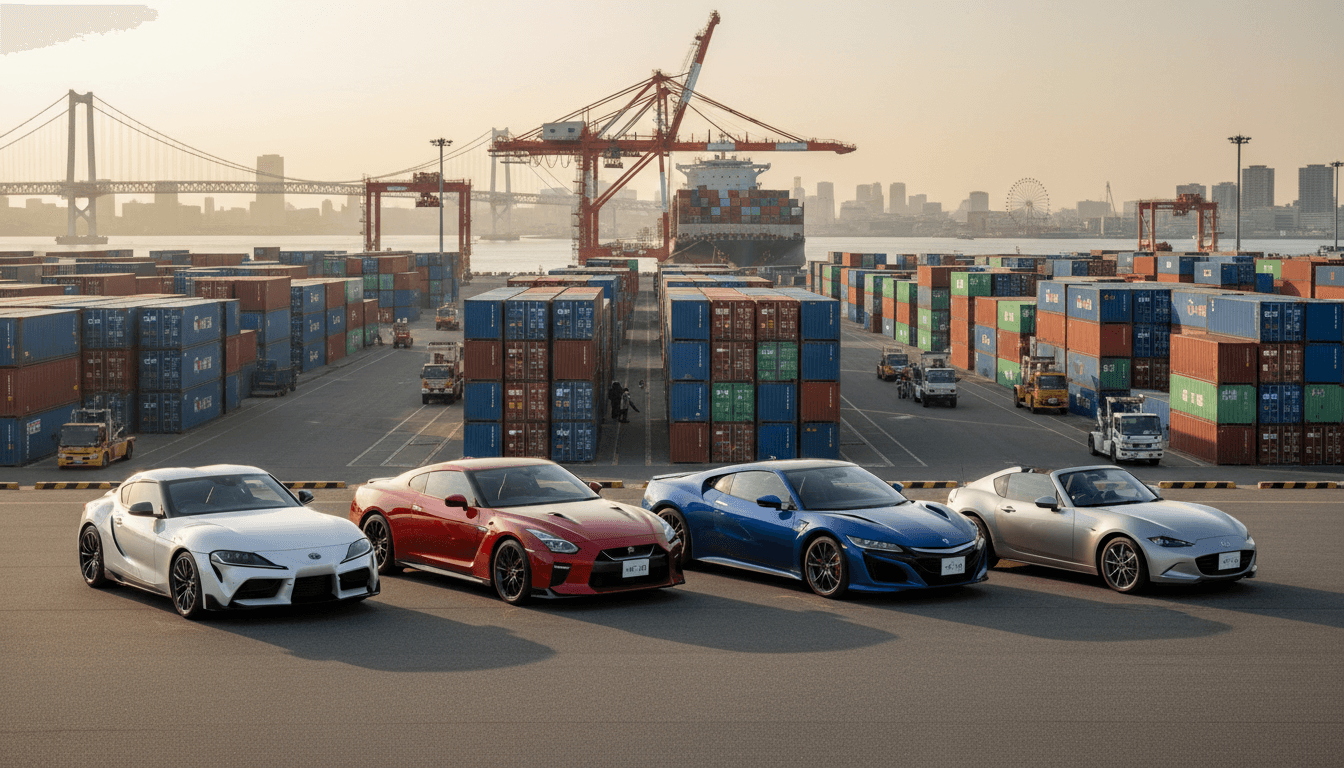
Introduction
The total cost to import a car from Japan ranges from around $10,000 on a modest used daily driver to well over $200,000 for a high-demand collector vehicle like a Nissan Skyline GT-R R34. Most mid-range JDM imports — a clean Toyota Land Cruiser Prado, an Evo VI, or a low-mileage Honda Civic Type R — land between $25,000 and $80,000 all-in, depending on your destination country and the compliance path required.
Japan is one of the world's largest vehicle export markets, shipping over 1.4 million used cars per year. Its auction system is globally trusted for transparent grading, its vehicles are renowned for reliability and meticulous maintenance records, and a weak yen has made Japanese car prices extremely competitive for foreign buyers in 2025 and 2026. For buyers in the USA, the landmark 25-year rule is opening up an increasingly exciting calendar of eligible JDM vehicles — 2001 model-year cars including the Lancer Evolution VII and Integra Type R DC5 become eligible month by month through 2026.
This guide covers every cost, every step, and every country-specific requirement you need to import a car from Japan in 2026.
Calculate your exact import duty for any car from Japan using CarImport.AI — it serves buyers in countries all over the world, with country-specific HS codes and live duty rates.
The Japan Export Process
Before a car boards a ship, it goes through a structured export procedure regulated by Japan's Ministry of Land, Infrastructure, Transport and Tourism (MLIT). Understanding this process helps you budget accurately and avoid delays.
Step 1: Finding and Buying the Vehicle
Foreigners cannot bid directly at Japanese auto auctions. The four major auction groups — USS (the largest network with around 20 locations), TAA Toyota, AA Japan, and Honda Cars — all require a licensed Japanese export agent to act as your representative. You can also browse and purchase through dealer stock or specialist JDM exporters who aggregate auction inventory.
Auction house buyer's fees typically run JPY 30,000–55,000 (roughly $200–$360) per vehicle. The total agent fee depends on vehicle value:
| Vehicle Price (JPY) | Typical Agent Fee |
|---|---|
| Under JPY 1,000,000 | JPY 80,000–100,000 (~$520–$650) |
| JPY 1,000,000–2,000,000 | ~JPY 100,000 (~$650) |
| Over JPY 2,000,000 | ~5% of purchase price |
Step 2: De-Registration and Export Certificate
Under Japan's amended Road Vehicle Law, any owner intending to export a registered vehicle must apply for Registration Deletion and obtain a Certificate of Registration Deletion from MLIT. The de-registration certificate fee is approximately JPY 30,000 (~$200), and the process typically takes 3–7 business days through your agent.
The Export Certificate (Yushutsu Menjyo) is the single most important document in the Japanese vehicle export process. It proves legal de-registration, confirms there are no outstanding loans on the vehicle, and certifies the vehicle has not been reported stolen. It serves as the legal title document for your import customs clearance in the destination country and is issued by the local transport authority.
Step 3: Export Customs Clearance
Japan's four major vehicle export ports are Yokohama, Osaka, Nagoya, and Kobe. The export process involves:
- Export Declaration submitted to Japanese Customs
- Physical inspection of the vehicle
- Export Permit issued
- MLIT confirmation of registration deletion
Pre-shipment requirements include draining the fuel tank to below 10 liters and passing a mandatory radiation check (implemented post-Fukushima 2011 for all exported vehicles). Vehicles shipped in containers must be clean of soil, seeds, and plant material to satisfy biosecurity requirements at destination countries. The JAAI (Japan Auto Appraisal Institute) oversees inspection procedures.
Japan Export Cost Summary
| Cost Item | Typical Range (USD) |
|---|---|
| Auction buyer's fee | $200–$360 |
| Agent fee (varies by vehicle price) | $520–5% of price |
| De-registration and export certificate | ~$200 |
| Inland transport to port | $100–$260 |
| Export documentation and customs | $100–$165 |
| Radiation check | Typically included in agent fee |
Get instant shipping quotes for your Japan import with IPAS EXPRESS Pro Car Shipping — live RoRo and container rates for all major Japan-origin corridors.
Shipping Costs from Japan by Destination
Shipping method selection is the single biggest variable in your Japan import budget. RoRo (Roll-on/Roll-off) is the most popular and typically the most cost-effective method for standard driveable vehicles. Container shipping (FCL — Full Container Load) offers superior protection for valuable or low-clearance vehicles, or when you want to include personal items. Air freight is reserved for urgent or ultra-high-value shipments.
Japan to USA (Los Angeles / Long Beach / Baltimore)
The Japan–USA corridor is one of the world's busiest vehicle shipping routes, with weekly RoRo departures from Yokohama and Nagoya operated by carriers including NYK Vehicle Carriers, Wallenius Wilhelmsen (EUKOR), Höegh, K-Line, and ONE.
| Method | Cost Range | Transit Time |
|---|---|---|
| RoRo | $900–$2,000 | 12–18 days (LA) / 25–30 days (Baltimore) |
| 20ft FCL Container | $1,500–$3,000 | 14–21 days |
| 40ft HC Container | $2,500–$4,200 | 14–21 days |
RoRo to Los Angeles is strongly preferred by JDM importers for its lower cost and frequent sailings. Baltimore is the primary East Coast port of entry.
Japan to Australia (Sydney / Melbourne / Brisbane)
Australia is one of Japan's largest used vehicle export markets. RoRo is the dominant method, with excellent service from Höegh, Wallenius Wilhelmsen, and NYK.
| Method | Cost Range (AUD) | Transit Time |
|---|---|---|
| RoRo | AUD $1,500–$2,500 | 15–25 days |
| 20ft FCL Container | AUD $2,500–$3,800 | 18–28 days |
| 40ft HC Container | AUD $4,000–$6,000 | 18–28 days |
Japan to United Kingdom (Southampton / Tilbury)
The Japan–UK route is a long-distance corridor with transits of 28–40 days for RoRo. Japan is a right-hand-drive market, so no steering conversion is required for UK imports — a major advantage over US-origin vehicles.
| Method | Cost Range (GBP) | Transit Time |
|---|---|---|
| RoRo | £800–£1,800 | 28–40 days |
| 20ft FCL Container | £1,500–£3,000 | 30–45 days |
| 40ft HC Container | £2,500–£4,500 | 30–45 days |
Japan to Canada (Vancouver / Halifax)
| Method | Cost Range (USD) | Transit Time |
|---|---|---|
| RoRo (Vancouver) | $900–$2,000 | 12–18 days |
| RoRo (Halifax) | $2,000–$3,500 | 25–32 days |
| 20ft FCL Container | $1,500–$3,000 | 15–22 days |
Japan to New Zealand (Auckland)
| Method | Cost Range (NZD) | Transit Time |
|---|---|---|
| RoRo | NZD $1,200–$2,200 | 15–25 days |
| 20ft FCL Container | NZD $2,000–$3,500 | 18–28 days |
Japan to UAE (Dubai / Jebel Ali)
The UAE is a highly active re-export hub, receiving Japanese vehicles and onshipping them to Africa and Asia.
| Method | Cost Range (USD) | Transit Time |
|---|---|---|
| RoRo | $700–$1,500 | 12–18 days |
| 20ft FCL Container | $1,200–$2,200 | 14–20 days |
Japan to Kenya (Mombasa) and South Africa (Durban)
Kenya and South Africa are major destinations for Japanese used vehicles. Many Kenya-bound cars transit via Jebel Ali or Colombo.
| Destination | RoRo Cost | Transit Time |
|---|---|---|
| Kenya (Mombasa) | $1,000–$2,000 | 20–30 days |
| South Africa (Durban) | $1,200–$2,500 | 22–35 days |
Customs Duty by Destination Country
Every destination country applies its own import duty structure to your vehicle's CIF value (Cost + Insurance + Freight). The total duty burden varies enormously — from around 10% in the UAE to over 60% in Kenya. Note that these are ranges; exact rates depend on your vehicle's engine capacity, fuel type, age, and HS code classification.
Calculate your exact import duty for any car from Japan using CarImport.AI — it serves buyers in countries all over the world, with country-specific HS codes and live duty rates.
USA
Vehicles 25 years or older from their manufacture date are exempt from NHTSA Federal Motor Vehicle Safety Standards (FMVSS) and, for vehicles 21 years or older, from EPA emissions requirements. Under the HTSUS code 9903.94.04, these exempt vehicles pay only 2.5% base duty — and are excluded from the Section 232 tariff.
For newer (non-exempt) vehicles, the Section 232 tariff effective from 16 September 2025 under the US-Japan trade agreement sets a combined minimum rate. Total customs burden for non-exempt Japanese vehicles is approximately 15% of CIF value. For 25-year-exempt vehicles, the rate remains 2.5% of CIF.
The difference is enormous in practice: a $100,000 car entering under the 25-year exemption attracts approximately $2,500 in duty. The same vehicle entering without the exemption faces approximately $15,000.
Australia
Australia applies a 5% import duty on the FOB (Free on Board) value of the vehicle, followed by 10% GST on the CIF value plus duty. For vehicles valued above approximately AUD $76,950 (the 2025–26 threshold), a 33% Luxury Car Tax (LCT) applies to the excess amount. Japan and Australia have an Economic Partnership Agreement (EPA) that may reduce duty to 0% for qualifying Japan-manufactured vehicles.
Typical total burden for non-luxury vehicles: 15–16% of CIF value.
United Kingdom
The UK-Japan Comprehensive Economic Partnership Agreement (CEPA), in force since 1 January 2021, provides 0% import duty for qualifying Japan-manufactured vehicles. Without CEPA qualification, the standard rate is 10% of CIF. VAT of 20% applies on top of the vehicle value plus duty. For classic cars 30 years old or more, duty drops to 0% and VAT to 5%.
Typical total burden (CEPA qualifying): approximately 20% (VAT only effective rate on net value).
Canada
Canada applies a 6.1% import duty, followed by Federal GST of 5% and provincial HST varying from 5% to 15% depending on province. Vehicles must be 15 years old or more to bypass Canadian Motor Vehicle Safety Standards (CMVSS) compliance requirements.
Typical total burden: 11–21% depending on province.
New Zealand
New Zealand has eliminated import duty on vehicles entirely (0%). GST of 15% applies on the CIF value. Japan is a right-hand-drive market, matching New Zealand's requirement — no conversion needed.
Typical total burden: approximately 15% of CIF.
UAE
The UAE applies a 5% GCC common external tariff and 5% VAT. No age restrictions apply and both RHD and LHD vehicles are accepted.
Typical total burden: approximately 10% of CIF.
Kenya
Kenya updated its import duty structure in July 2025: import duty reduced from 35% to 25% of CRSP (Current Retail Selling Price), with excise duty of 20% applied to the sum of CRSP plus import duty, and VAT of 16% applied to the cumulative base. The Import Declaration Fee (IDF) increased from 2.25% to 3.5%. Kenya's 8-year age limit is strictly enforced — vehicles over 8 years from the year of manufacture cannot be imported.
Typical total burden: 55–65% of CRSP value.
Compliance Costs by Country
USA: The 25-Year Rule in Detail
The 25-year rule is counted from the month and year of manufacture, not the model year. For example, a vehicle manufactured in March 2001 becomes eligible from March 2026 — not on 1 January 2026. This matters for buyers racing to import specific models.
Vehicles qualifying for the 25-year exemption in 2026 (manufactured in 2001, opening month by month):
- Mitsubishi Lancer Evolution VII (CT9A)
- Honda Integra Type R (DC5)
- Honda Civic Type R (EP3)
- Nissan Skyline GT-R R34 M-Spec Nur (late 2001 production runs)
Already fully eligible (manufactured 1999–2000):
- Nissan Skyline GT-R R34 (all variants through mid-2000)
- Honda S2000 (1999 onwards)
- Mitsubishi Evolution VI
- Mazda RX-7 FD3S (through 2000)
- Toyota Chaser JZX100, Nissan Silvia S15 (early production)
For non-exempt vehicles under 25 years old, FMVSS compliance conversion costs $5,000–$28,500 depending on the vehicle and the required modifications. California buyers face additional CARB emissions compliance requirements.
Australia: SEVS and RAW Compliance
Vehicles 15 years old or older can be imported under the Specialist and Enthusiast Vehicle Scheme (SEVS), subject to approval. As of 2025, all SEVS applications must be submitted through the ROVER portal — paper-based applications are no longer accepted.
After arrival, vehicles must undergo a Register of Approved Vehicles (RAW) compliance inspection and workshop modification to meet Australian Design Rules (ADRs). Costs:
| Compliance Step | Cost Range (AUD) |
|---|---|
| RAW compliance workshop | AUD $1,500–$5,000+ |
| Asbestos inspection (mandatory) | AUD $300–$600 |
| Biosecurity inspection (DAWE) | AUD $200–$400 |
| Quarantine treatment (if required) | AUD $500–$1,500 |
| Total port and quarantine fees | ~AUD $1,200 |
Japan is an RHD market — no steering conversion is required for Australian imports.
UK: IVA and NOVA
Japan's right-hand-drive configuration is already correct for the UK, eliminating the major conversion cost that US-origin vehicles require. UK-specific compliance steps:
| Step | Cost | Timeline |
|---|---|---|
| Individual Vehicle Approval (IVA) fee | £456 (Basic) to £1,012+ (Normal) | 4–12 weeks |
| NOVA notification | Free | Within 14 days of arrival |
| MOT test | ~£54.85 | After compliance |
Historic vehicles 40 years old or more can use age-related registration, bypassing the full IVA requirement entirely.
Canada: 15-Year Rule
Vehicles 15 years or older are exempt from CMVSS compliance. The Registrar of Imported Vehicles (RIV) fee is CAD $295 plus applicable taxes. A recall clearance letter from the manufacturer is required. Provinces vary in their emissions testing requirements.
New Zealand
Entry Certification (NZD $400–$800) and a biosecurity inspection (NZD $300–$600) are required after arrival. Japan is RHD — no conversion needed. The process typically takes 1–3 weeks post-arrival.
Top JDM Cars to Import in 2026
These are the most sought-after models in global JDM import circles, with their current auction price ranges and key eligibility notes:
| Vehicle | Typical Years | Auction Price (USD) | Key Notes |
|---|---|---|---|
| Nissan Skyline GT-R R34 | 1999–2002 | $80,000–$200,000+ | 1999–2000 fully US-eligible; 2001 opens month-by-month 2026 |
| Toyota Supra JZA80 | 1993–2002 | $50,000–$150,000 | 2JZ engine; massive tuning community |
| Honda NSX NA1/NA2 | 1990–2005 | $40,000–$120,000 | Mid-engine exotic; Acura NSX in USA market |
| Mazda RX-7 FD3S | 1992–2002 | $20,000–$60,000 | Rotary engine; California CARB issues for non-exempt |
| Mitsubishi Lancer Evo VI–VII | 1999–2001 | $15,000–$45,000 | Evo VII becomes US-eligible throughout 2026 |
| Subaru Impreza WRX STI 22B | 1998 | $60,000–$120,000 | 400-unit limited edition |
| Honda Civic Type R EK9/EP3 | 1997–2005 | $12,000–$35,000 | Never officially sold in USA |
| Nissan Silvia S15 | 1999–2002 | $20,000–$55,000 | RWD drift platform |
| Toyota Land Cruiser 80/100 | 1990–2007 | $15,000–$60,000 | Diesel options not available in USA domestically |
| Toyota Chaser/Mark II JZX100 | 1996–2001 | $8,000–$25,000 | FR layout; 1JZ/2JZ engines |
Total Cost Examples: Three Worked Scenarios
Example A: 1999 Nissan Skyline GT-R R34 to USA
This vehicle is fully 25-year eligible as of 2024 and pays only 2.5% base duty — no Section 232 tariff applies.
| Cost Item | Low Estimate | High Estimate |
|---|---|---|
| Auction purchase | $80,000 | $150,000 |
| Auction buyer's fee (~5%) | $4,000 | $7,500 |
| Japan agent fee | $2,500 | $4,000 |
| De-registration and export certificate | $300 | $500 |
| Inland transport to port | $200 | $400 |
| RoRo (Japan to Los Angeles) | $1,200 | $2,000 |
| Marine insurance (1.5%) | $1,200 | $2,250 |
| US CBP import duty (2.5% on CIF) | $2,200 | $4,100 |
| ISF filing fee | $150 | $150 |
| Port handling and customs broker | $500 | $800 |
| Domestic transport (LA to buyer) | $400 | $1,500 |
| State registration | $200 | $800 |
| FMVSS/EPA compliance | $0 | $0 |
| Total Landed Cost | ~$92,850 | ~$174,000 |
Example B: 2015 Toyota Land Cruiser Prado to Australia
| Cost Item | Low Estimate (AUD) | High Estimate (AUD) |
|---|---|---|
| Auction purchase | AUD $46,000 | AUD $70,000 |
| Japan agent fee and auction fee | AUD $2,000 | AUD $3,500 |
| De-registration and export docs | AUD $500 | AUD $700 |
| RoRo (Japan to Sydney/Melbourne) | AUD $1,500 | AUD $2,500 |
| Marine insurance | AUD $700 | AUD $1,200 |
| Australian import duty (5%) | AUD $2,300 | AUD $3,500 |
| GST (10%) | AUD $5,300 | AUD $8,200 |
| Luxury Car Tax (if applicable) | AUD $0 | AUD $5,000 |
| Port, quarantine, and biosecurity | AUD $1,200 | AUD $1,800 |
| RAW compliance workshop | AUD $1,500 | AUD $4,000 |
| Asbestos inspection | AUD $300 | AUD $600 |
| State registration | AUD $600 | AUD $1,200 |
| Total Landed Cost | ~AUD $62,000 | ~AUD $102,000 |
Example C: 2018 Honda Civic Type R to USA — Why It Does Not Work
The 2018 Honda Civic Type R (FK8) is 8 years old in 2026 and does not become 25-year eligible until 2043. This creates a prohibitive compliance burden:
- FMVSS compliance conversion: $15,000–$28,500
- Section 232 tariff at approximately 15% of CIF value
- Vehicle auction value: $20,000–$35,000
- Estimated total landed cost: $65,000–$90,000
At those numbers, the import math makes no sense — a modern 2024 Civic Type R can be purchased new in the USA for $44,990. This example illustrates why the 25-year rule is not just a compliance formality but a fundamental economic gating mechanism for JDM imports to the USA.
Timeline: From Auction Win to Registration
USA (25-Year Exempt Vehicle)
| Stage | Duration |
|---|---|
| Finding and winning at auction | 1–4 weeks |
| Japan processing (de-registration, export cert, customs) | 2–3 weeks |
| Port staging and vessel booking | 1–2 weeks |
| RoRo transit (Japan to Los Angeles) | 12–18 days |
| CBP customs clearance | 3–10 business days |
| Domestic transport to buyer | 3–7 days |
| State DMV registration | 1–3 weeks |
| Total | 8–14 weeks |
Australia
| Stage | Duration |
|---|---|
| Finding and auction | 1–4 weeks |
| Japan processing and ROVER SEVS approval | 2–4 weeks |
| Port staging | 1–2 weeks |
| RoRo transit (Japan to Sydney/Melbourne) | 15–25 days |
| ABF customs clearance and biosecurity | 1–3 weeks |
| RAW compliance workshop | 3–8 weeks |
| State registration | 1–2 weeks |
| Total | 12–22 weeks |
United Kingdom
| Stage | Duration |
|---|---|
| Finding and auction | 1–4 weeks |
| Japan processing | 2–3 weeks |
| Shipping (Japan to Southampton) | 28–40 days |
| HMRC clearance and NOVA notification | 1–2 weeks |
| IVA inspection | 4–12 weeks |
| DVLA registration and MOT | 1–2 weeks |
| Total | 16–28 weeks |
| Historic vehicles (no IVA required) | 10–14 weeks |
Risks and How to Avoid Them
Understanding the Japanese Auction Grading System
Every vehicle sold through a major Japanese auction receives a standardised grade. Understanding these grades is essential before committing to a purchase:
| Grade | Condition Description |
|---|---|
| S | Showroom condition or near-new |
| 5 | Excellent — very minor marks only |
| 4.5 | Very good — small scratches, no accident repairs |
| 4 | Good — light scratches, minor dents |
| 3.5 | Average-good — noticeable scratches, some minor repairs |
| 3 | Average — visible marks, light repairs visible |
| 2 | Below average — significant repairs evident |
| 1 | Heavy damage |
| 0 | Non-runner or severe damage |
| RA | Repaired accident damage (disclosed) |
Interior grades run from A (excellent) to D (notable damage or stains). For export purposes, the minimum recommended grade is 3.5 or above. Interior grade B or better is advisable for vehicles that will undergo compliance inspection.
Common Risks and Mitigation
Agent fraud or unlicensed exporters. Work only with agents who can provide their Japanese Motor Vehicle Dealer Association membership number and a verifiable export history. Ask for auction sheet images and pre-purchase inspection reports (shakken status).
Odometer fraud. Japan's domestic culture strongly discourages odometer manipulation, but it is not unknown in vehicles prepared specifically for export. Always cross-check the auction sheet odometer reading against service records and the vehicle's JAAI inspection record.
Hidden structural damage. Grade RA indicates disclosed accident repairs. Vehicles without RA grades can still have hidden repairs on less-scrutinized panels. Commission an independent JAAI inspection for any vehicle above $20,000.
Compliance cost underestimation. Many buyers budget for shipping and customs but forget RAW compliance (Australia), IVA (UK), or FMVSS conversion (USA non-exempt). These costs can add $5,000–$30,000 to the landed cost and must be factored in from the start.
Currency risk. Auction prices are quoted in JPY. A significant yen movement between auction win and payment can alter your effective purchase price materially. Some agents offer forward contracts or rapid settlement to manage this exposure.
New vs Used: The Case for New Car Import
Used Japanese domestic market vehicles dominate this guide because that is what most importers are seeking — specific JDM models that were never available in their home market, or high-quality used vehicles at prices below local equivalents.
However, the auction process carries inherent risks: hidden mechanical issues not captured in grade sheets, compliance surprises, long timelines, and increasingly high prices for the most desirable models as global demand intensifies.
Japan also produces a number of new vehicles that remain Japan-exclusive or have meaningful specification differences from export variants:
- Toyota GR Yaris (Japan dealer price approximately JPY 4.5M–5.5M / USD $30,000–$37,000)
- Honda Civic Type R FL5 (Japan-specific colors and interior options)
- Nissan GT-R Nismo and Special Edition variants
- Lexus LC 500 special editions
- Mitsubishi Delica D:5
New Japan-market vehicles typically carry a 15–25% premium over equivalent 2–3 year used examples. But they come with full manufacturer documentation, no hidden history, and no compliance uncertainty regarding prior accident repairs.
IPAS exports brand-new vehicles from our origin markets — no auction risk, no unknown history, manufacturer documentation included. Browse our catalog for vehicles available for direct export.
2025–2026 Regulatory Changes
Several regulatory changes affect Japan car imports in 2025 and 2026. Staying current on these is essential for accurate cost planning.
USA: Section 232 Tariff (Effective 16 September 2025)
The US-Japan trade agreement implementing Section 232 vehicle tariffs took effect on 16 September 2025. Japanese vehicles under 25 years old now face a combined minimum duty rate of approximately 15% of CIF value. Critically, vehicles qualifying under the 25-year rule (HTSUS 9903.94.04) remain at just 2.5% base duty and are expressly excluded from Section 232. This makes the 25-year threshold more financially significant than ever.
25-Year Rule 2026 Calendar
The 2001 model year opens throughout 2026, with eligibility determined by the actual month of manufacture, not the calendar year. Key models becoming eligible month by month in 2026:
- Mitsubishi Lancer Evolution VII CT9A
- Honda Integra Type R DC5
- Honda Civic Type R EP3
- Nissan Skyline GT-R R34 M-Spec Nur (late 2001 production)
Australia: ROVER Portal Mandatory (2025)
The ROVER portal is now the only accepted channel for all SEVS approvals. Paper-based applications were phased out in 2025. The Australian Border Force (ABF) updated guidance as of March 2026. Importers must obtain ROVER Vehicle Import Approval (VIA) before the vehicle is purchased or shipped.
UK-Japan CEPA (In Force Since 1 January 2021)
The UK-Japan Comprehensive Economic Partnership Agreement provides 0% import duty for qualifying Japan-manufactured vehicles, down from the prior 6.5% rate. To qualify, the vehicle must meet the agreement's rules of origin — in practice, this is met by virtually all Japan-domestically-manufactured vehicles. UK buyers importing directly from Japan in 2026 should ensure their customs broker codes the entry under the CEPA tariff preference.
Kenya: July 2025 Duty Restructure
Kenya's July 2025 restructuring reduced import duty on vehicles from 35% to 25% of CRSP, but increased the Import Declaration Fee (IDF) from 2.25% to 3.5%. The CRSP (Current Retail Selling Price) database was fully updated. The 8-year age limit on imports remains strictly enforced — vehicles manufactured more than 8 years before the import date are barred from entry.
Frequently Asked Questions
How much does it cost to import a car from Japan to the USA?
Total costs for a 25-year-eligible vehicle range from approximately $10,000 to $200,000+, depending on the purchase price. For a typical mid-range JDM model (auction price $15,000–$40,000), expect total landed costs of $20,000–$55,000 including auction fees, agent costs, shipping (around $1,200–$2,000 for RoRo to Los Angeles), US customs duty (2.5% for 25-year-exempt), and domestic transport. For non-25-year-exempt vehicles, factor in an additional $15,000–$28,500 for FMVSS compliance conversion and approximately 15% Section 232 tariff.
What is the 25-year rule for importing Japanese cars?
The 25-year rule exempts vehicles from NHTSA Federal Motor Vehicle Safety Standards compliance when the vehicle is 25 or more years old from its month and year of manufacture. Vehicles 21 years or older are also exempt from EPA emissions requirements. Under HTSUS code 9903.94.04, 25-year-exempt Japanese vehicles pay only 2.5% base import duty and are excluded from the Section 232 tariff. Eligibility is determined by the actual manufacture date, not the model year — a vehicle manufactured in August 2001 becomes eligible in August 2026, not on 1 January 2026.
How long does it take to import a car from Japan?
Timeline varies significantly by destination and vehicle type. For a 25-year-exempt USA import via RoRo to Los Angeles: expect 8–14 weeks total from auction win to state registration. For Australia (including RAW compliance): 12–22 weeks. For the UK (including IVA): 16–28 weeks, or 10–14 weeks for historic vehicles exempt from IVA. New Zealand is among the fastest at 8–14 weeks.
Do I need to convert a Japanese car to left-hand drive?
It depends on your destination. Japan is a right-hand-drive (RHD) country. If you are importing to another RHD market — Australia, New Zealand, the UK, Kenya, South Africa — no steering conversion is required. If you are importing to a left-hand-drive market such as Germany, France, or most continental European countries, a full LHD conversion adds €15,000–€30,000 or more, making most imports economically unviable unless the vehicle is a collector piece. The USA accepts both RHD and LHD vehicles, making Japanese imports straightforward from a steering perspective.
What is the cheapest way to ship a car from Japan?
RoRo (Roll-on/Roll-off) is almost always the cheapest method for standard driveable vehicles. For Japan to Los Angeles, RoRo typically costs $900–$2,000. Container shipping in a 20ft FCL runs $1,500–$3,000 for the same route but provides superior protection for valuable, low-clearance, or modified vehicles. Air freight is the most expensive method (typically $5,000–$15,000+) and is only justified for ultra-high-value or extremely time-sensitive shipments.
Can I import a used car from Japan to Australia?
Yes. Australia imports large volumes of used Japanese vehicles each year. Vehicles must be 15 years or older to qualify for SEVS (Specialist and Enthusiast Vehicle Scheme) approval, though some newer vehicles qualify as specialist vehicles not sold new in Australia. The ROVER portal must be used for all SEVS applications. After arrival, vehicles must pass RAW (Register of Approved Vehicles) compliance, which costs approximately AUD $1,500–$5,000. Since Japan is RHD, no steering conversion is needed.
What Japanese cars are legal to import to the USA in 2026?
Any Japanese vehicle that is 25 years or older from its actual manufacture date is fully legal to import to the USA under the 25-year NHTSA/EPA exemption. In 2026, this includes all vehicles manufactured in 2001 or earlier, with specific models opening eligibility month by month as their actual manufacture date reaches the 25-year mark. Notable models becoming eligible throughout 2026 include the Mitsubishi Lancer Evolution VII, Honda Integra Type R DC5, and Honda Civic Type R EP3. Already fully eligible models include all R34 Skyline GT-R variants (1999–early 2000 production), Honda S2000, Mazda RX-7 FD3S, and Mitsubishi Evolution VI. Vehicles under 25 years old can technically be imported but require expensive FMVSS compliance conversion ($5,000–$28,500) and face the Section 232 tariff of approximately 15%.
Is it worth importing a car from Japan?
For 25-year-eligible vehicles in the USA, importing from Japan is often the only way to legally own iconic JDM models — the R34 GT-R, Evo VII, or Civic Type R EP3 simply were never sold new in the USA. The import process is legitimate and well-established, and landed costs, while significant, are often the only avenue to ownership. For buyers in Australia, New Zealand, and the UK, Japan remains an excellent source of high-quality used vehicles at competitive prices — the strong quality of the Japanese auction system, combined with the RHD advantage, makes it one of the world's best used vehicle markets. The process is worth it when you are buying a specific model you cannot get locally, you have researched compliance requirements fully, you are working with a reputable licensed agent, and the total landed cost still represents value versus local alternatives.
Ready to Import Your Vehicle from Japan?
Whether you are chasing a specific JDM icon, sourcing a high-quality used workhorse, or exploring what a brand-new Japan-market exclusive would cost to bring home, the total landed cost calculation is the essential first step — and it needs to be precise.
Two tools to get you there:
CarImport.AI — Source a vehicle through IPAS and calculate the full landed cost — customs duties, shipping, and compliance — to destinations across the world. Get your exact import cost for any Japanese vehicle in seconds.
IPAS EXPRESS Pro Car Shipping — Already have a vehicle? Get instant shipping quotes — sea freight, air freight, or RoRo — for one car or multiple vehicles from Japan to anywhere in the world.
Ready to Import Your Vehicle?
Two tools, two use cases. Pick the one that fits your needs.

Source a vehicle through IPAS and calculate the full landed cost — customs duties, shipping, and compliance — to destinations across the world.
Calculate Landed CostIPAS Express
Already have a vehicle? Get instant shipping quotes — sea freight, air freight, or RoRo — for one car or multiple vehicles worldwide.
Get Shipping Quote