
Introduction
The United Arab Emirates is one of the easiest places in the world to import a car into — and one of the most misunderstood. Its tax architecture is the simplest of any market IPAS serves: a 5% customs duty followed by 5% VAT, and nothing else. No excise on motor vehicles, no luxury tax, no engine-capacity surcharge, no CO2 levy. A car landing in Dubai or Abu Dhabi pays a total of 10.25% of its CIF value in import charges, which is roughly a fifth of what the same car would pay arriving in Sri Lanka, India or Taiwan.
That simplicity on the tax side is balanced by real strictness on the admissibility side. The UAE drives on the right, so a mainland-registered car must be left-hand drive — the Dubai RTA stopped registering right-hand-drive vehicles in 2019. There is a hard 10-year age ceiling measured from the date of manufacture, a ban on salvage and flood-damaged cars, and a tightening emissions ladder that pushes the whole market to Euro 6b by mid-2027. Above all, no car reaches a UAE number plate without a GSO Certificate of Conformity and its VIN sitting in the GSO database.
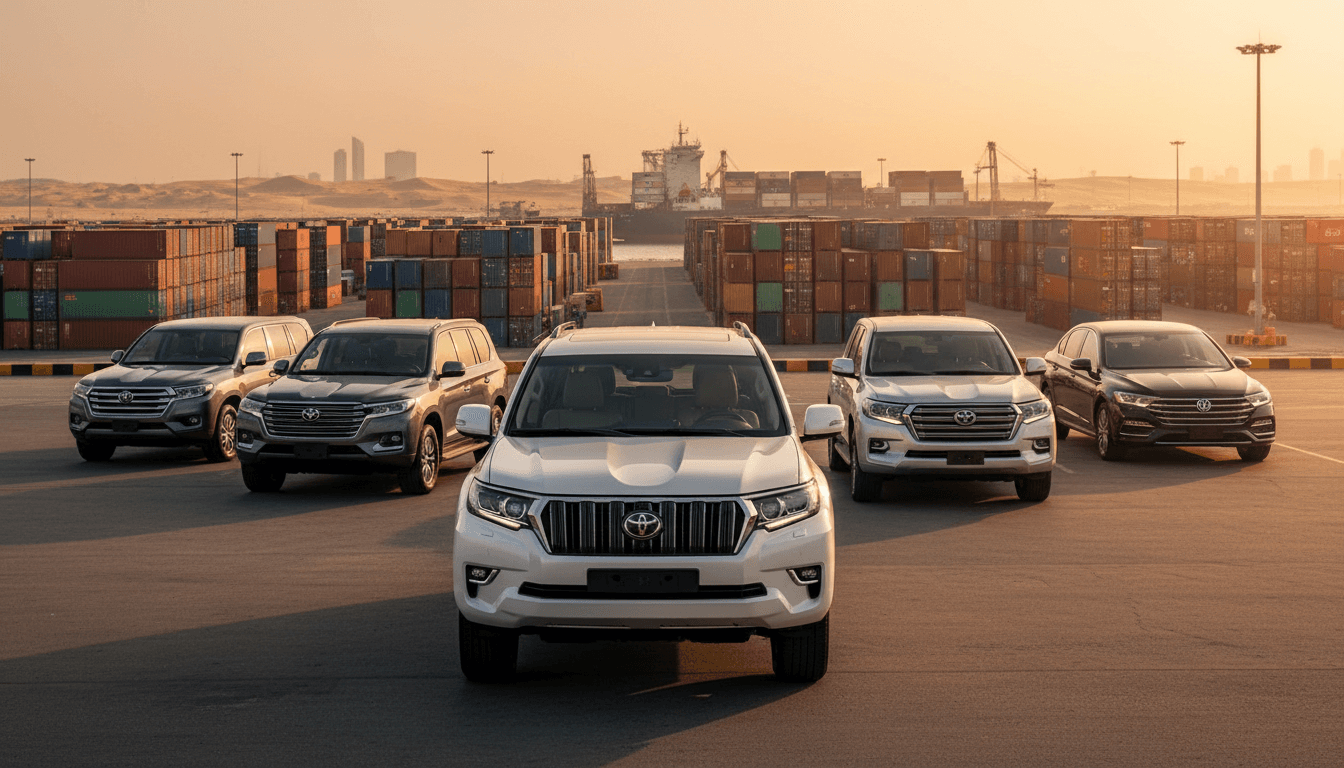
The UAE also plays a second role that no other market in this guide series plays: it is the world's largest vehicle re-export hub. Cars that could never be registered on UAE roads — right-hand-drive Land Cruisers bound for Kenya, twenty-year-old sedans, Japanese-domestic-spec imports — pass legally through UAE free zones every day, because free-zone admissibility answers to the destination country's rules, not the UAE's. Understanding the difference between a mainland import and a free-zone transit is the single most important thing to get right before you buy.
This guide covers both: the mainland route (what you can register, what it costs, how to clear it) and the free-zone route (what transits, what it costs, and the 180-day clock you must not miss).
Quick Facts
| Detail | Information |
|---|---|
| Trade Bloc | GCC Customs Union (Gulf Cooperation Council) |
| Customs Authority | Federal Customs Authority (customs.gov.ae), enforced by Dubai Customs, Abu Dhabi Customs, Sharjah Customs |
| Tax Authority | Federal Tax Authority — tax.gov.ae |
| Standards / Type Approval | Ministry of Industry and Advanced Technology (MOIAT) + GSO |
| Registration Authority | Emirate-level — Dubai RTA, Abu Dhabi ITSC, and equivalents |
| Traffic Side | Right-hand traffic (drive on the right) |
| Steering Requirement | LHD mandatory for mainland registration; RHD not registrable since 2019 |
| Customs Duty | 5% of CIF (GCC Common Customs Tariff) |
| VAT | 5%, charged on (CIF + customs duty) |
| Excise | None — motor vehicles are outside the UAE excise regime |
| Luxury / CO2 / engine-capacity tax | None |
| Total import charges | 10.25% of CIF (mainland, MFN origin) |
| Intra-GCC origin | 0% duty with a valid GCC Certificate of Origin; 5% VAT still applies |
| Electric Vehicles | No federal customs duty exemption — 5% MFN applies. Emirate registration-fee waivers are separate |
| Vehicle Age Limit | 10 years from date of manufacture (mainland registration) |
| Classic exemption | 30+ years — emirate-discretion "brown plate" pathway |
| Salvage / flood / rebuilt | Banned for mainland registration since 1 May 2017 |
| Emissions | Euro 6b for new types from January 2026; Euro 5 carryover to 30 June 2027; Euro 6b for all imports from 1 July 2027. US standards accepted as equivalent |
| Pre-shipment inspection | Not required — compliance is verified after arrival |
| Pickup Classification | All pickups (single, extended and double cab) sit under HS 8704, not 8703 |
| Main Seaports | Jebel Ali (Dubai), Khalifa Port (Abu Dhabi), Port Rashid, Hamriyah and Khor Fakkan (Sharjah), Saqr Port (RAK) |
| Currency | UAE Dirham (AED), pegged at 3.6725 to the US dollar |
Types of Cars That Can Be Imported
The UAE allows both new and used passenger cars, but the admissibility gates decide far more than the tax rate does.
New and Used Vehicles
Both are permitted. New cars are the cleanest path because they arrive with a current GSO Certificate of Conformity and comfortably meet the emissions standard. Used cars are permitted up to the age ceiling but need the MOIAT Product Status Statement workflow, which is slower and more document-heavy for a private individual.
Age — a hard 10-year ceiling
The UAE applies a 10-year limit measured from the date of manufacture, not the date of first registration. This catches people out: a car first registered in 2018 but built in late 2016 is measured from 2016. The cutoff is read from the VIN and the chassis plate. Beyond 10 years the vehicle cannot be registered on the mainland at all — though it can still transit a free zone for re-export.
Cars 30 years and older fall outside this rule under the classic-vehicle pathway, registered on brown plates at the emirate's discretion and with usage restrictions. Dubai applies this more restrictively than Abu Dhabi.
Steering — LHD only
The UAE drives on the right and requires left-hand drive for mainland registration. Dubai RTA formally ceased registering RHD vehicles in 2019, citing the GCC-wide ministerial resolution agreed in Bahrain in 2001. There is no RTA-approved conversion framework — commercial workshops will convert a car, but no workshop can guarantee that the RTA will then register it. Treat RHD as inadmissible for mainland use.
This matters less than it might, because every major IPAS source market for the UAE — the USA, Germany, Japan's export-spec lines, South Korea — supplies left-hand-drive vehicles. No conversion is required or budgeted.
Condition — no salvage
Since 1 May 2017, burnt, flood-damaged, rebuilt, non-repairable and insurer-written-off vehicles have been banned from mainland registration and insurance. Note the precise scope: the ban applies to registration and insurance, not to import and transit, so salvage cars remain admissible to free zones for re-export or parts recovery.
Fuel Type
All fuel types are admissible and, importantly, all pay the same duty. Battery EVs, plug-in hybrids, conventional hybrids, petrol and diesel cars are all 5% MFN.
Cars You Can Import to the UAE
Each card is a full landed-cost calculation for the United Arab Emirates: the car's price, shipping, every duty and tax, and handling, worked out on 9 November 2026 with the rules in force that day. All are left-hand drive to suit the United Arab Emirates's roads. Tap a car to see its full breakdown, or open it to change the trim, colour or port.
More cars you can import to the UAE
New cars IPAS sources to order that meet the UAE's import rules. Prices are ex works, before shipping and duty. Open a car to work out its full landed cost.
 RHDBackorder2026
Mahindra XUV 3XO
SUV · 29 VariantsPetrol · DieselFrom $8,500Ex Works, India LHDBackorder2026
Lexus ES
Sedan · 12 VariantsHybrid · ElectricFrom $52,500Ex Works, Canada LHDBackorder2026
Toyota bZ
SUV · 5 VariantsElectricFrom $41,900Ex Works, USA LHDBackorder2026
Toyota Land Cruiser
SUV · 2 VariantsHybridFrom $69,100Ex Works, USA RHDBackorder2026
Toyota Hilux Travo
Pickup · 11 VariantsDieselFrom $27,100Ex Works, Thailand LHDBackorder2026
Infiniti QX60
SUV · 6 VariantsPetrolFrom $61,900Ex Works, USA RHDBackorder2026
Suzuki Alto K10
Hatchback · 8 VariantsPetrol · CNGFrom $4,800Ex Works, India RHDBackorder2026
Suzuki Swift
Hatchback · 14 VariantsPetrol · CNGFrom $6,700Ex Works, India RHDBackorder2026
Suzuki Fronx
SUV · 16 VariantsPetrol · CNGFrom $7,600Ex Works, India RHDBackorder2026
Hyundai Bayon
SUV · 11 VariantsPetrolFrom $9,100Ex Works, India LHDBackorder2026
GMC Acadia
SUV · 5 VariantsPetrolFrom $52,600Ex Works, USA RHDBackorder2026
Mercedes-Benz AMG GLE
SUV · 6 VariantsHybrid · Plug-in HybridFrom $131,000Ex Works, UK LHDBackorder2026
Chevrolet Colorado
Pickup · 7 VariantsPetrolFrom $41,400Ex Works, USA RHDBackorder2026
Chevrolet Corvette E-Ray Coupe
Coupe · 1 VariantHybridFrom $168,900Ex Works, NZ RHDBackorder2026
Chevrolet Corvette Stingray Coupe
Coupe · 2 VariantsPetrolFrom $120,200Ex Works, NZ LHD/C-RHDBackorder2025
Ford Super Duty F-250
Pickup · 10 VariantsPetrol · DieselFrom $54,400Ex Works, USA
Seaports and Airports Supporting Vehicle Import
The UAE has the deepest vehicle-handling port infrastructure in the Middle East, and most of it is purpose-built for exactly this trade.
| Port | Emirate | Role |
|---|---|---|
| Jebel Ali (JEBEL ALI) | Dubai | The primary vehicle gateway. DP World-operated, JAFZA-adjacent, handles the largest RoRo and container volumes in the region |
| Port Rashid | Dubai | Older city-centre port; cruise and general cargo, some vehicle movements |
| Khalifa Port | Abu Dhabi | AD Ports-operated, KEZAD free-zone-linked, growing vehicle capacity |
| Hamriyah Port | Sharjah | Free-zone-linked, used heavily by auto and heavy-goods traders |
| Khor Fakkan | Sharjah | East-coast deepwater terminal outside the Strait of Hormuz |
| Saqr Port | Ras Al Khaimah | Bulk-focused; RAKEZ-linked |
Air Freight
Dubai International and Al Maktoum International handle air-freighted vehicles through DAFZA, which is the standard route for supercars, classics and time-critical shipments. It is dramatically more expensive than sea and is not the default for a normal import.
The DUCAMZ distinction
The Dubai Auto Zone (DUCAMZ) at Ras Al Khor, established in 2000 and supervised by JAFZA, is the world's largest automotive free zone. It exists specifically to sort inbound vehicles into two streams: left-hand-drive stock destined for UAE mainland sale, and right-hand-drive stock destined for re-export to Africa, South Asia and other RHD markets. If your vehicle is not going onto UAE roads, this is almost certainly where it will sit.
Restrictions on Vehicle Import for Individuals
- Mainland registration requires UAE residency. You need an Emirates ID, a UAE driving licence and a UAE address to register a car in your own name. A tourist or non-resident cannot register a mainland vehicle.
- Free-zone import does not require residency — but it does require a company. The importing entity in a free zone is a UAE-registered FZCO or FZE holding a trade licence that permits vehicle trading. An individual cannot hold free-zone stock personally.
- The 180-day free-zone clock. Vehicles admitted to a free zone must be re-exported within 180 days of customs admission. Dubai Customs penalties for overrunning are AED 1,000 per bill of entry per month, plus 10% of CIF value as a non-re-export penalty. Extensions are negotiable case by case with JAFZA or DUCAMZ for high-value or specialist consignments, but they are not automatic.
- Free-zone transit confers no origin. This is the most expensive misunderstanding in the region. A Japanese-built Land Cruiser that passes through DUCAMZ does not acquire UAE or GCC origin, and does not qualify for the intra-GCC 0% rate when it moves on to Kuwait or Saudi Arabia. Only a car genuinely manufactured in a GCC state, with a valid GCC Certificate of Origin meeting the 40% value-add rule, gets the zero rate.
- No VIN in the GSO database, no registration. MOIAT and GSO are electronically linked and MOIAT queries the GSO database at registration. This is a hard gate, and it is the one that most often strands a grey-market import.
Duty Structure Overview
The UAE runs a two-component cascade — the simplest structure of any market IPAS calculates for:
- Customs Duty at 5% of the CIF value.
- VAT at 5% on (CIF + customs duty).
That is the whole thing. There is no excise on motor vehicles (Cabinet Decision 99 of 2025 amended the excise framework but pointedly did not extend it to vehicles), no luxury or selective tax, no engine-capacity surcharge and no federal CO2 levy.
Customs valuation
The customs value is the CIF value — purchase price plus international freight and insurance to the UAE port — assessed under the transaction-value method of the GCC Common Customs Law. Convert using the Federal Customs Authority's published rate at the time of declaration, not your bank's spot rate. Because the dirham has been pegged at 3.6725 to the dollar since 1997, the two rarely diverge by much.
One point specific to free zones: when a vehicle moves from a free zone into the UAE mainland, duty is assessed on the original CIF value at the UAE port of entry, not on some internal free-zone transfer price. You cannot reduce the duty base by re-invoicing inside the zone.
The cascade, worked
| Charge | Rate | Base |
|---|---|---|
| Customs Duty | 5% | CIF |
| VAT | 5% | CIF + Customs Duty |
| Excise | none | — |
| Total | 10.25% | of CIF |
Worked example 1 — Petrol SUV from the USA, CIF US$50,000
| Charge | Calculation | Amount |
|---|---|---|
| Customs value (CIF) | — | $50,000 |
| Customs duty (5%) | $50,000 × 0.05 | $2,500 |
| VAT (5%) | ($50,000 + $2,500) × 0.05 | $2,625 |
| Excise | none | $0 |
| Total import charges | $5,125 (10.25% of CIF) | |
| Landed cost | $55,125 |
Worked example 2 — Battery EV from Germany, CIF US$60,000
| Charge | Calculation | Amount |
|---|---|---|
| Customs duty (5%) | $60,000 × 0.05 | $3,000 |
| VAT (5%) | ($60,000 + $3,000) × 0.05 | $3,150 |
| Total import charges | $6,150 (10.25% of CIF) |
An EV pays exactly the same as a petrol car. There is no federal duty concession for electrification — see the next section, because this is the most commonly misreported fact about the UAE.
Worked example 3 — GCC-manufactured car with a valid GCC Certificate of Origin, CIF US$40,000
| Charge | Calculation | Amount |
|---|---|---|
| Customs duty | 0% (intra-GCC) | $0 |
| VAT (5%) | $40,000 × 0.05 | $2,000 |
| Total import charges | $2,000 (5.00% of CIF) |
These figures show the structure. Get the exact duty and full landed cost for your specific vehicle, origin and shipping route using CarImport.AI.

Calculate your exact import duty to the UAE
Get a vehicle-specific duty and full landed-cost breakdown — HS classification, every tax, levy and FTA, plus shipping — calculated for your exact make, model and specs.
- Vehicle-specific HS code
- All duties, taxes & FTAs
- Shipping + est. landed cost
Free trade agreements
The UAE has an unusually wide FTA network, but very little of it currently helps a car importer:
| Agreement | In force | Practical effect on cars |
|---|---|---|
| GCC Customs Union (intra-GCC) | 2003 | 0% duty — confirmed, with a valid GCC Certificate of Origin and 40% value-add |
| UAE–India CEPA | May 2022 | Annex 2B unconfirmed for vehicles — assume 5% MFN |
| UAE–Indonesia CEPA | Sep 2023 | Unconfirmed — assume 5% MFN |
| UAE–Australia CEPA | Oct 2025 | Unconfirmed — assume 5% MFN |
| UAE–Korea CEPA | May 2026 | Just in force; annex unconfirmed — assume 5% MFN |
| GCC–Singapore, GCC–EFTA | 2013 / 2014 | Vehicle lines unconfirmed — assume 5% MFN |
| EU, UK, USA, Japan, China, Canada, Thailand | No FTA | 5% MFN |
IPAS applies a deliberately conservative rule here: quote MFN unless the agreement's annex explicitly places the vehicle line at a preferential rate and valid origin documentation is in hand. Because the MFN rate is only 5%, the downside of that conservatism is small.
Worked Example: Importing a 2026 Cadillac Escalade to the UAE
Here is the full landed cost of one car, a 2026 Cadillac Escalade shipped from the USA to the United Arab Emirates (one EU member, as an example), worked out on 9 November 2026 with the customs rules in force that day. It lands at 496,595 AED (about US$135,220), and duties and taxes come to 10.2% of its CIF value.
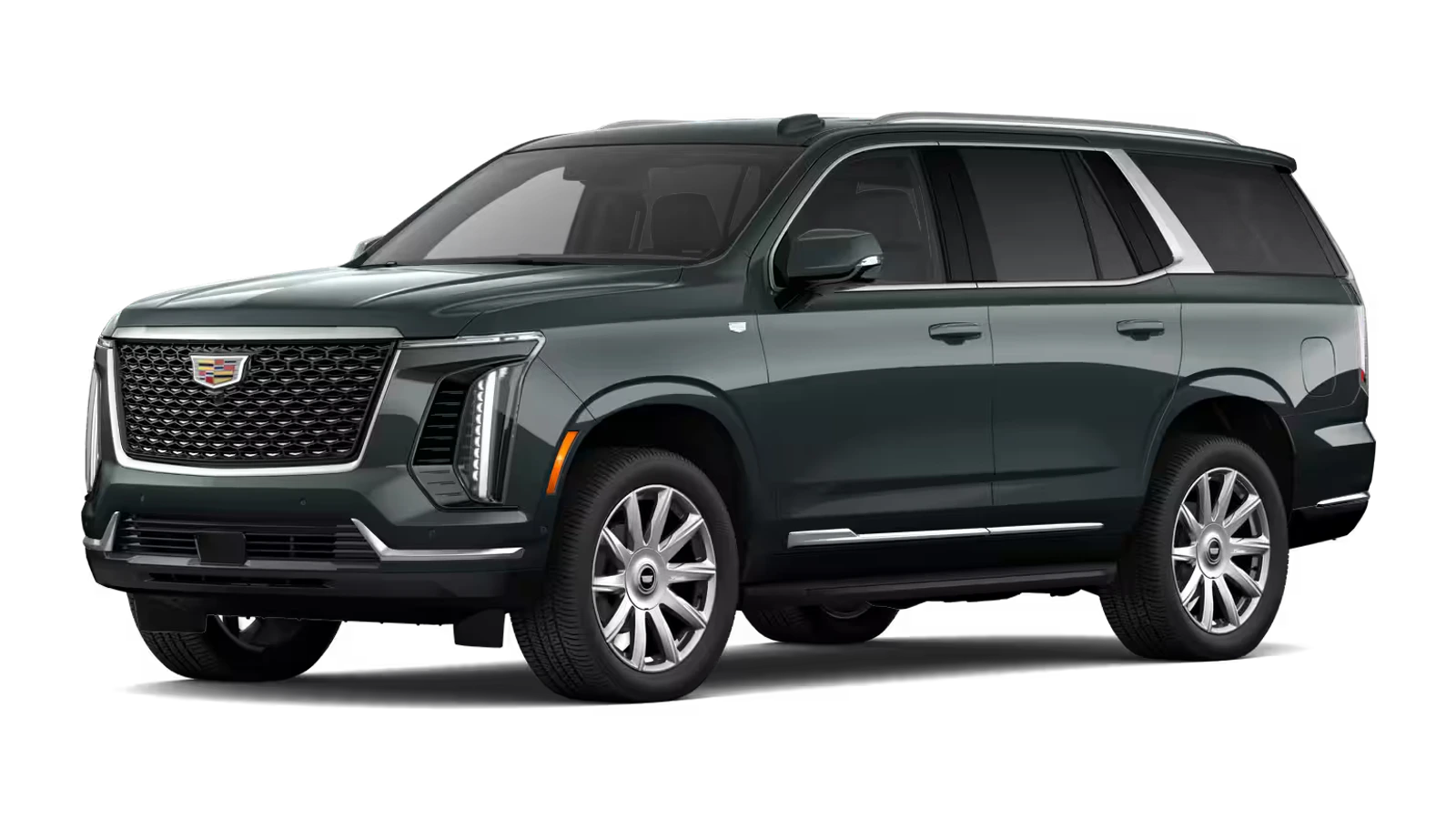
| Item | Share of CIF | Amount |
|---|---|---|
| Vehicle priceIPAS price for a car sourced in the USA | 401,404 AEDUS$109,300 | |
| Shipping and insuranceUSA to United Arab Emirates | 30,144 AEDUS$8,208 | |
| CIF valueCost, insurance and freight: the customs value | 431,548 AEDUS$117,508 | |
| Customs duties and taxes | ||
| Basic customs duty (5%)5% of CIF | 21,576 AEDUS$5,875 | |
| GST/VAT (5%)5% of CIF plus the duties above5.2% of CIF | 22,656 AEDUS$6,169 | |
| Total duties and taxes10.2% of CIF | 44,232 AEDUS$12,044 | |
| Service and handling | ||
| Premium Import ServiceOptional end-to-end import management by IPAS | 14,036 AEDUS$3,822 | |
| Destination handlingPort terminal and customs clearance handling | 6,779 AEDUS$1,846 | |
| Total landed cost | 496,595 AEDUS$135,220 | |
Electric and Hybrid Vehicles
This is the area where public information about the UAE is most often wrong, so it is worth being precise.
There is no federal customs duty exemption for electric vehicles in the UAE. Battery EVs (HS 8703.80), plug-in hybrids and conventional hybrids all pay the standard 5% MFN duty and 5% VAT, exactly like a petrol car.
The widely repeated claim that "the UAE waived the 5% duty on EVs" conflates two separate things:
- Emirate registration-fee incentives. Dubai's RTA has offered registration-fee waivers of up to 100% for EVs, and Abu Dhabi's ITSC has reduced fees. These are genuine and valuable — but they are post-customs registration incentives applied after the car has already cleared and paid duty. They do not touch the customs bill.
- Cabinet Resolution No. 50 of 2024 and standard UAE.S 2698:2024. This is an EV technical standards mandate covering charging and safety requirements, effective around May 2025. It is a compliance obligation, not a tax concession.
No instrument in the UAE Official Gazette or the Federal Customs Authority notice database provides a federal customs duty exemption for any electrified powertrain. Until one is published, budget an EV import at the full 10.25%.
The genuine EV advantages in the UAE are real but sit elsewhere: free or discounted registration and parking in some emirates, Salik toll exemptions in certain schemes, and an expanding public charging network.
Pickup Trucks — A UAE-Specific Classification Rule
If you are importing a pickup, the UAE classifies it differently from most of the world, and it is worth knowing why even though it does not change your tax bill.
Every pickup — single-cab, extended-cab or double-cab — classifies under HS 8704 (goods vehicles) in the UAE, not HS 8703 (passenger cars). The UAE's 12-digit national tariff states this explicitly, with code 87042110 covering diesel pickups in single or double cabin, and 87043120 covering petrol double-cabs.
The GCC applies the WCO body-style test: an open cargo bed makes it a goods vehicle, and adding a rear passenger cab does not reclassify it. This is the opposite of how the USA, India, Malaysia, Australia and New Zealand treat the same vehicle.
The rate impact is zero — both HS 8703 and HS 8704 are 5% MFN in the UAE. What it does affect is the type-approval route, the registration category (commercial versus private plate), and the paperwork. Vehicles confirmed under HS 8704 in the UAE include the Toyota Hilux, Ford Ranger, Mitsubishi Triton, Isuzu D-Max, RAM 1500, Toyota Tundra and Ford F-150.
Do not carry this classification across to another country's calculation — the same F-150 sits under HS 8703 in several other markets.
Documents Required for Import
A consistent document set is the difference between a three-day clearance and a three-week one. The VIN must match exactly across every document.
For customs clearance
- Commercial invoice — CIF and FOB values must match the declaration
- Bill of Lading (original or telex release), or Air Waybill
- Packing list showing make, model, year, VIN, engine capacity and colour
- Certificate of Origin — mandatory to claim any FTA preference, recommended in all cases
- Certificate of Title or equivalent ownership document (US Title, UK V5C, German Fahrzeugbrief)
- Previous-country registration certificate
- Mirsal2 customs declaration, filed electronically through the Dubai or Abu Dhabi customs portal
For mainland registration
- GSO Certificate of Conformity — and the VIN must appear in the GSO database
- MOIAT Product Status Statement (used vehicles)
- Emirates ID, UAE driving licence and proof of UAE address
- UAE motor insurance certificate
- Customs clearance certificate and proof of duty and VAT payment
For a free-zone importer
- Free-zone trade licence permitting vehicle trading (FZCO or FZE)
- Mirsal2 "Import for Re-Export from Free Zone" declaration
- Customs bond or guarantee where the zone authority requires one
Customs Clearance Timeline
| Stage | Typical duration | Notes |
|---|---|---|
| Vessel arrival to discharge | 1–3 days | Jebel Ali and Khalifa Port both run quickly |
| Mirsal2 declaration and duty assessment | 1–2 working days | Electronic; same-day is common with a clean file |
| Duty and VAT payment, customs release | 1 day | Payment is electronic |
| MOIAT / GSO conformity verification | 3–10 working days | The main variable; much faster if the VIN is already in the GSO database |
| RTA technical inspection and registration | 1–3 days | Requires insurance in place first |
| Typical total, mainland | 1–3 weeks | Assuming complete documents |
| Free zone admission (transit only) | 1–3 days | No duty, no VAT; 180-day re-export clock starts |
Delays cluster around two things: a VIN missing from the GSO database, and a Certificate of Conformity that does not explicitly say "Euro 6 for UAE". Certificates marked "Not applicable for UAE" are rejected outright by MOIAT.
Homologation and Vehicle Approval
GSO Certificate of Conformity
This is the central compliance document and it is mandatory for mainland registration. The manufacturer or importer submits documentation, GSO issues the certificate, the VIN is added to the GSO database, and MOIAT queries that database when you register. Without both the certificate and the database entry, mainland registration is impossible.
The certificate must state "Euro 6 for UAE" explicitly. This sounds like a formality; it is not. Certificates issued for other GCC markets, or annotated "Not applicable for UAE", are rejected.
Emissions ladder
The September 2025 GSO workshop set out the timetable clearly:
| Stage | Applies to | Standard | Effective |
|---|---|---|---|
| Current | New types, new imports | Euro 6b | From January 2026 |
| Current | Carryover models | Euro 5 permitted | Until 30 June 2027 |
| Current | Carryover registration | Euro 5 registerable | Until 1 January 2028 |
| Future | All imports, light and heavy | Euro 6b mandatory | 1 July 2027 |
| Future | New type approvals | Euro 6d | Model year 2030 |
| Future | All new registrations | Euro 6d | 1 January 2031 |
Two clarifications matter for sourcing. US emissions standards are accepted as equivalent to Euro 6b, which keeps American-market cars viable. And a European Type Approval issued under Regulation (EU) 2018/1832 is sufficient on its own — no separate UAE emissions test is required.
Other mandates
Cabinet Resolution 84 of 2024 made eCall a type-approval requirement from 2024. Federal Decree-Law 14 of 2024, the new Traffic Regulation, came into force on 29 March 2025 with executive regulations following in September 2025.
Unlike Kenya's PVoC or Nigeria's SONCAP, the UAE requires no mandatory pre-shipment inspection. Compliance is checked after arrival, at MOIAT and RTA testing centres — which is convenient but also means a non-compliant car is already in the country before you find out.
Registration Procedures and Costs
Registration is handled by the emirate, not federally, so the exact fees vary between Dubai, Abu Dhabi and the northern emirates. The sequence is consistent:
- Clear customs and obtain the customs clearance certificate showing duty and VAT paid.
- Obtain the MOIAT / GSO conformity confirmation for the VIN.
- Arrange UAE motor insurance — you cannot register without an active policy.
- Present the vehicle for technical inspection at an RTA-approved testing centre (Dubai) or the emirate equivalent. The inspection checks VIN, chassis and engine numbers, lighting, brakes and modifications.
- Register and receive plates — the registration card is issued electronically and physical plates are fitted.
Budget for the vehicle test, the registration card, plate issuance and the annual insurance premium. Personalised and short-digit plates are sold separately at auction and can cost more than the car.
Note the residency requirement again here: Emirates ID, UAE driving licence and a UAE address are all prerequisites. If you do not hold UAE residency, the free-zone route is your only option, and that requires a licensed company.
Recent Regulatory Changes (2024–2026)
- 30 November 2024 — customs law amendment. Federal Decree No. 167 of 2024 ratified amendments to the GCC Common Customs Law, brought into force per Dubai Customs Notice 01/2025.
- 2024 — eCall mandated. Cabinet Resolution 84 of 2024 added eCall to type-approval requirements.
- 29 March 2025 — new Traffic Regulation. Federal Decree-Law 14 of 2024 entered into force, with executive regulations issued in September 2025.
- ~May 2025 — EV technical standards. Cabinet Resolution 50 of 2024 and UAE.S 2698:2024 took effect. Standards only — not a duty change.
- 23 July 2025 — 12-digit tariff rollout. Dubai Customs Notice 10/2025 began a phased migration to the 12-digit GCC Integrated Customs Tariff. For imports from outside the GCC, 8-digit codes remain valid through July 2026, with 12-digit codes mandatory from 1 August 2026.
- 18 September 2025 — emissions timetable set. The GSO workshop fixed the Euro 6b and Euro 6d ladder described above.
- 2025 — excise unchanged for vehicles. Cabinet Decision 99 of 2025 amended the excise framework without extending it to motor vehicles.
- 1 May 2026 — UAE–Korea CEPA entered into force. Hyundai, Kia and Genesis are material origins, so this is worth watching, but the vehicle annex is not yet confirmed and MFN remains the safe assumption.
Frequently Asked Questions
How much does it cost to import a car to the UAE?
Import charges come to 10.25% of the CIF value — 5% customs duty, then 5% VAT calculated on the CIF plus that duty. There is no excise, luxury tax or engine-capacity surcharge. A car with a CIF of $50,000 pays $5,125 in total. On top of that you should budget shipping, port and clearance handling, insurance, the technical inspection and emirate registration fees. Use CarImport.AI for an exact figure including freight for your specific route.
Are electric cars exempt from import duty in the UAE?
No. This is the single most common misconception about the UAE. EVs pay the same 5% customs duty and 5% VAT as any petrol car — there is no federal customs exemption for battery-electric, plug-in hybrid or hybrid vehicles. What does exist is emirate-level registration fee relief, such as Dubai RTA's waiver of up to 100% on registration fees, plus toll and parking incentives. Those are applied after customs and do not reduce your duty bill.
Can I import a right-hand-drive car to the UAE?
Not for use on UAE roads. The UAE drives on the right and Dubai RTA stopped registering right-hand-drive vehicles in 2019, in line with a GCC-wide ministerial resolution. There is no approved conversion pathway that guarantees registration. RHD vehicles are, however, perfectly admissible to UAE free zones for onward re-export to right-hand-drive markets — that is a large part of what DUCAMZ exists to do.
What is the age limit for importing a car to the UAE?
Ten years, measured from the date of manufacture rather than first registration — so check the VIN and chassis plate, not the logbook. Cars older than that cannot be registered on the mainland, though they can still transit a free zone for re-export. Vehicles 30 years and older can be registered under the classic-vehicle brown-plate scheme at the emirate's discretion, with usage restrictions.
Do I need to be a UAE resident to import a car?
To register a car on the mainland in your own name, yes — you need an Emirates ID, a UAE driving licence and a UAE address. Free-zone import and re-export does not require personal residency, but it does require a UAE free-zone company (FZCO or FZE) holding a trade licence that covers vehicle trading.
Will a car sourced through a UAE free zone qualify for 0% duty elsewhere in the GCC?
No, and this is an expensive assumption to get wrong. Passing through a UAE free zone does not confer UAE or GCC origin. A Japanese-built Land Cruiser re-exported from DUCAMZ to Kuwait or Saudi Arabia is still Japanese-origin and still pays the standard rate. The intra-GCC 0% rate requires a vehicle genuinely manufactured in a GCC state, supported by a valid GCC Certificate of Origin meeting the 40% value-add threshold.
How long does customs clearance take?
For a mainland import with complete documents, expect one to three weeks end to end. The customs steps themselves are fast — the declaration, assessment and payment often complete within two to three working days. The variable is MOIAT and GSO conformity verification, which runs three to ten working days and moves much faster if the VIN is already in the GSO database. Free-zone admission for pure transit is quicker, typically one to three days.
Can I import a salvage or flood-damaged car?
Not for registration. Burnt, flood-damaged, rebuilt, non-repairable and insurer-written-off vehicles have been banned from UAE mainland registration and insurance since 1 May 2017. They remain admissible to free zones for re-export or parts recovery — the ban targets registration and insurance, not import and transit.
Ready to Import?
The UAE rewards getting the front end right. The tax side is genuinely simple and genuinely low — 10.25% of CIF, with no excise or luxury tax to trip over — so the money is rarely where imports go wrong. What goes wrong is admissibility: a right-hand-drive car that cannot be registered, a vehicle a few months past the 10-year manufacture cutoff, or a Certificate of Conformity that does not name the UAE. Check those three things before you buy and the rest is straightforward.
If your vehicle cannot meet the mainland gates, that is not the end of the route — it is the beginning of a different one. The free-zone framework at DUCAMZ and JAFZA exists precisely so that right-hand-drive, older and specialist vehicles can move legally through the UAE to the markets where they can be registered.
IPAS provides two tools to plan and execute your import:
CarImport.AI — Source a vehicle through IPAS and calculate the full landed cost to the UAE, including the 5% customs duty, 5% VAT and shipping. Get exact figures for your specific vehicle, origin and route, and see whether an intra-GCC origin claim is available to you.
IPAS EXPRESS — Already have a vehicle? Get instant shipping quotes to Jebel Ali, Khalifa Port or Sharjah — sea freight, RoRo or air — with transparent, itemised pricing and a stage-by-stage timeline.
Ready to Import Your Vehicle?
Two tools, two use cases. Pick the one that fits your needs.
Source a vehicle through IPAS and calculate the full landed cost — customs duties, shipping, and compliance — to destinations across the world.
Calculate Landed CostIPAS Express
Already have a vehicle? Get instant shipping quotes — sea freight, air freight, or RoRo — for one car or multiple vehicles worldwide.
Get Shipping Quote